Key Highlights:
AI agents will access websites through browsers and dedicated protocols.
Google CEO Sundar Pichai says protocols could offer a more scalable approach.
Google's UCP aims to support AI-powered shopping through Gemini and AI Mode.
Businesses should improve website accessibility, content quality, and technical SEO to prepare for AI-driven interactions.
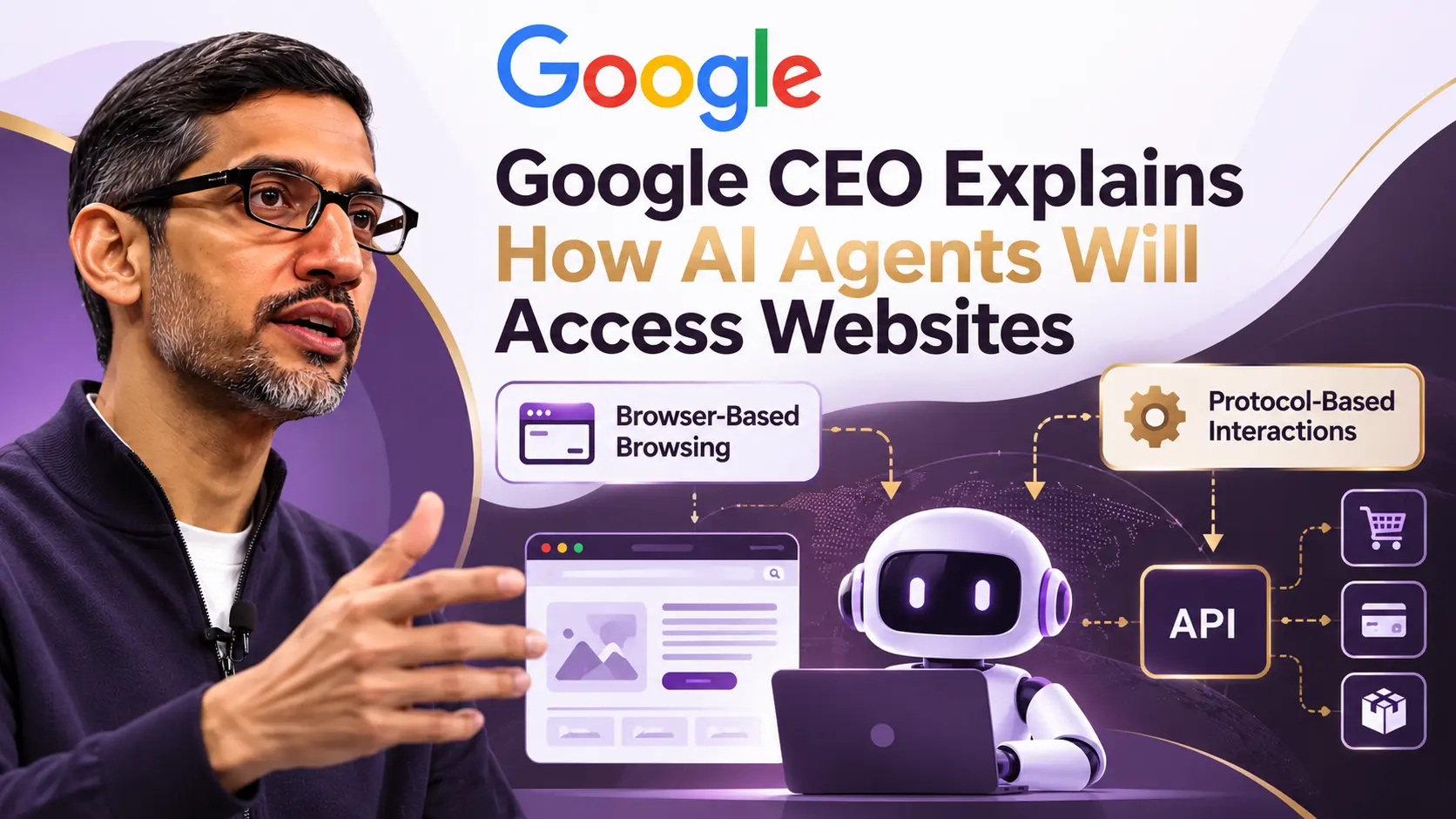
Google CEO Sundar Pichai expects AI agents to access websites through two approaches: browser-based navigation and dedicated protocols designed for automated interactions. His comments highlight how AI could reshape website accessibility, SEO, and online commerce.
Speaking to Alex Heath on the Sources podcast, Pichai explained that both approaches will develop, although protocols could eventually provide a more scalable solution.
“I think you have both ways and they’re going to develop,” Google CEO Sundar Pichai said.
Two Ways AI Agents Will Interact With Websites
1. Browser-Based Browsing
AI agents can navigate websites, read content, compare products, and interact with website features. This approach allows agents to work with existing websites without requiring every business to develop dedicated integrations.
Pichai described browser-based computer use as “a very elegant way to work too, because that’s what you as a user would do.”
2. Protocol-Based Interactions
Protocols allow compatible systems to communicate through standardised methods. Google's Universal Commerce Protocol (UCP) aims to support AI-powered shopping experiences, including commerce interactions through Google AI Mode and Gemini.
Pichai described protocols as “a far more scalable approach” but noted that developing them would take longer.
How AI Agents Will Impact SEO and Businesses
AI agents are changing how users discover websites and interact with online services. Businesses should focus on clear website structures, accurate content, and accessible navigation.
E-commerce businesses should also monitor Google's Universal Commerce Protocol (UCP) to understand how AI-powered shopping may affect product discovery and purchases.
Pichai emphasised a user-first approach, stating, “The right answer longer term is you put users first and say what would users want.”
The Future of AI Search
AI agents could increasingly help users research products, compare services, and complete online tasks. Businesses may therefore need to prepare their websites for both traditional search visibility and AI-driven interactions.
For now, strong technical SEO, useful content, and a user-friendly website remain essential foundations for adapting to this evolving landscape.