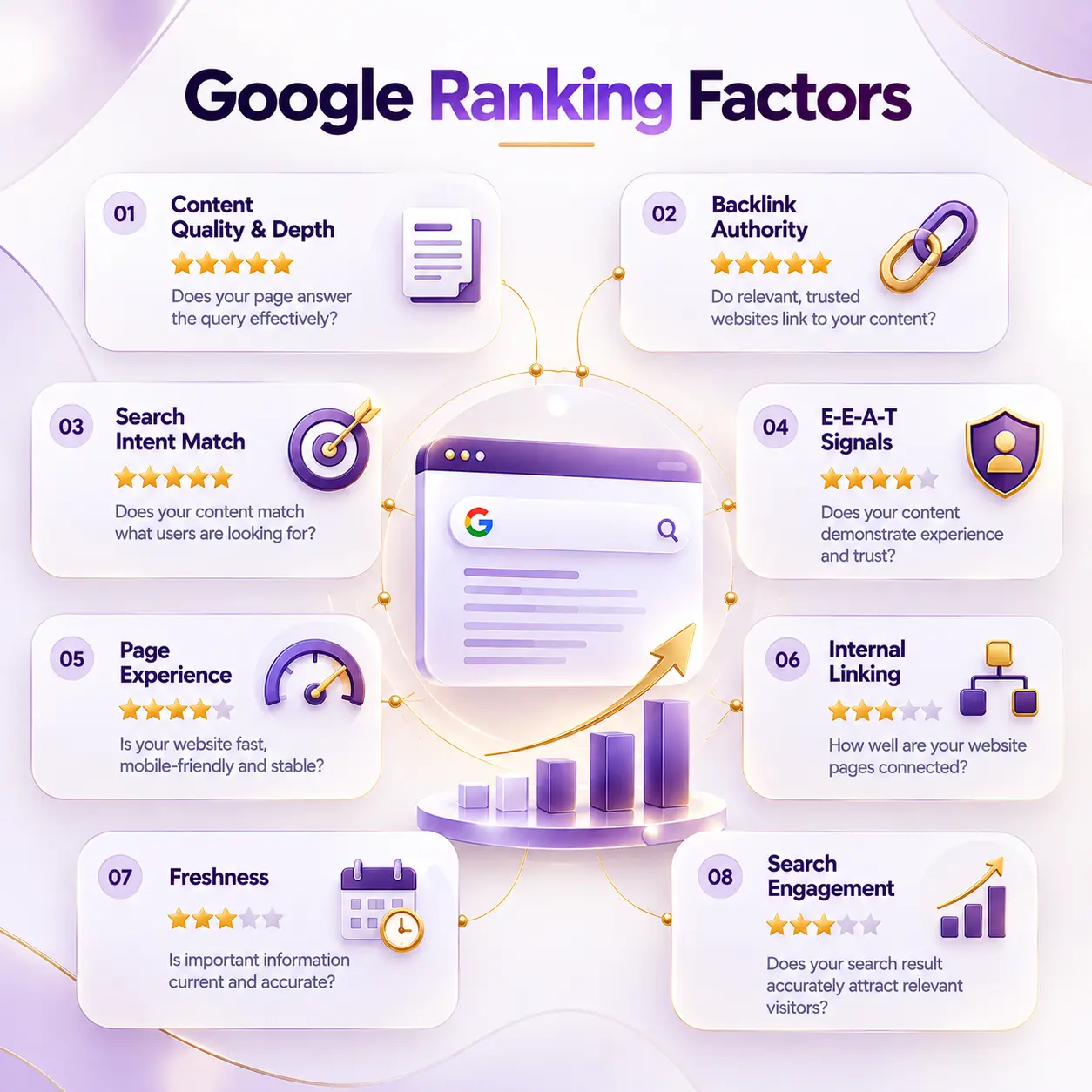

E-E-A-T stands for Experience, Expertise, Authoritativeness, and Trustworthiness. It is a framework Google uses when evaluating the quality and reliability of content.
E-E-A-T is not a single Google ranking factor or score. Instead, it helps explain the qualities that can make content more useful, credible, and trustworthy for users.
E — Experience
Experience shows that the content creator has first-hand experience with the subject.
Instead of writing only general information, include real examples, case studies, screenshots, testing results, project outcomes, and practical observations.
For example, an SEO professional writing about technical SEO can explain how a specific optimisation was implemented on a website and what happened afterward.
Example:
“I tested this SEO strategy on three websites and monitored the results for six months.”
This provides evidence of practical experience rather than simply repeating information found elsewhere.
E — Expertise
Expertise demonstrates that the author has a strong understanding of the topic.
Good SEO content should explain concepts accurately and use appropriate terminology without making the information unnecessarily complicated.
For example, an SEO article may cover:
Crawling and indexing
Search intent
Internal linking
Technical SEO
Structured data
Core Web Vitals
Content optimisation
Author information can also help readers understand who created the content and why that person is qualified to discuss the subject. - Google's people-first content guidance
A — Authoritativeness
Authoritativeness develops when a website, author, or organisation becomes recognised as a reliable source within a particular subject.
Relevant signals can include:
Industry publications
Expert contributions
Original research
Professional profiles
Relevant citations
Industry mentions
Quality backlinks
Demonstrated subject knowledge
Authority should be relevant to the topic. A large number of unrelated links or mentions does not automatically make a website authoritative.
T — Trustworthiness
Trust is a critical part of E-E-A-T. Users should be able to understand who created the content, where the information came from, and whether the website is reliable.
A trustworthy website should provide:
Clear author information
Accurate business details
Reliable sources
HTTPS security
Genuine reviews
Transparent claims
Updated information
Clear contact information
Avoid fake reviews, misleading claims, unsupported statistics, and copied content.
E-E-A-T Example: Two Finance Blogs
Imagine two websites publish an article about personal finance.
Website A publishes content written by identified authors, references reliable financial sources, explains the topic clearly, and includes practical experience and original analysis.
Website B publishes a generic article that repeats information found on other websites without identifying the author or providing supporting sources.
Both websites may target the same keyword, but the first article gives readers more evidence about who created the content, how the information was developed, and why it can be trusted.
This is where E-E-A-T becomes useful as a content-quality framework.
E-E-A-T and Google SEO Rankings
E-E-A-T should not be treated as a checklist where completing four items automatically improves rankings.
Google uses multiple systems and signals to determine which content is helpful and relevant for a search query. There is no single E-E-A-T score that determines a page's position in Google Search. Google Search ranking systems
A strong SEO strategy should therefore combine content quality with other fundamentals such as:
Search intent
Original and useful information
Technical SEO
Internal linking
Relevant page titles
Clear website structure
Mobile usability
Page experience
Appropriate structured data
For technical performance, Core Web Vitals and page experience provide additional guidance for creating a better experience for users.
How to Apply E-E-A-T to Your SEO Content
A simple approach is to ask four questions before publishing:
Experience:
Have we included something based on real experience or testing?
Expertise:
Does the content demonstrate genuine knowledge of the subject?
Authority:
Are relevant and credible sources supporting important information?
Trust:
Can users clearly understand who created the content and where the information came from?
You can also use Google's SEO Starter Guide when reviewing your broader SEO fundamentals.
E-E-A-T and Semantic SEO
E-E-A-T also works well with a broader semantic SEO approach.
Instead of repeatedly using one keyword such as SEO services, create content around related concepts such as:
SEO strategy, search intent, organic search, technical SEO, content quality, Google Search, website authority, structured data, Core Web Vitals, helpful content, and search visibility.
These terms should appear naturally where they help explain the topic. The goal is to build a complete understanding of the subject rather than repeatedly inserting the same keyword.
For example, when discussing structured data, you can reference Google's structured data documentation rather than adding an unrelated keyword-heavy link.
Key Takeaway
E-E-A-T is about showing rather than simply claiming credibility.
Show your experience through real examples. Demonstrate expertise through accurate information. Build authority through genuine recognition and relevant sources. Most importantly, make your content and business information trustworthy.
The strongest approach is to create helpful, reliable, people-first content that answers the user's question and provides information that is genuinely useful.